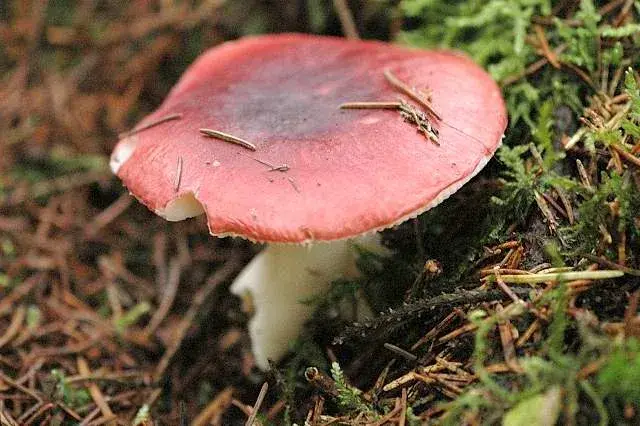
Burning brittlegill grows from June to October; host trees: spruce, pine. Inedible and not for the table; this page does not replace an in-person check.
It tastes mild and almond-like, and its spore print is ochre-yellow. The burning brittlegill, by contrast, has a lustreless cap, often a red stem, smells of cedarwood and becomes extremely hot after a while.
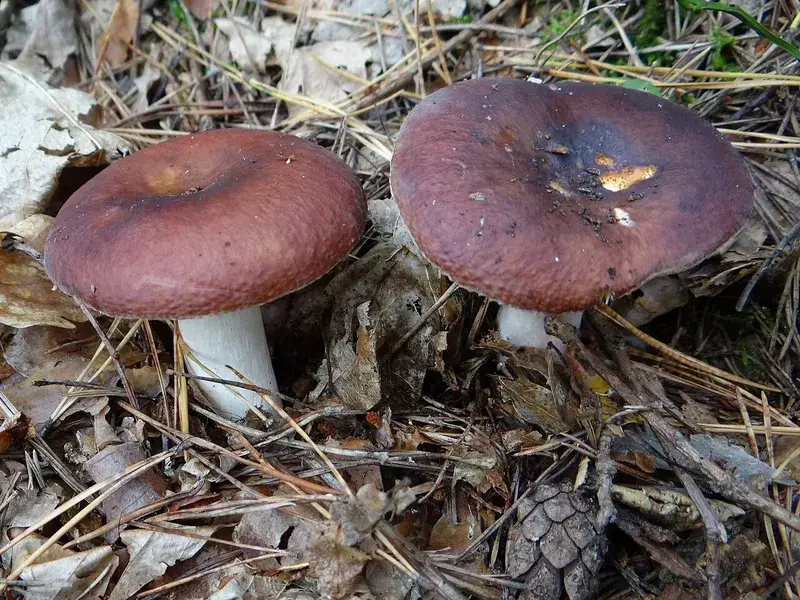
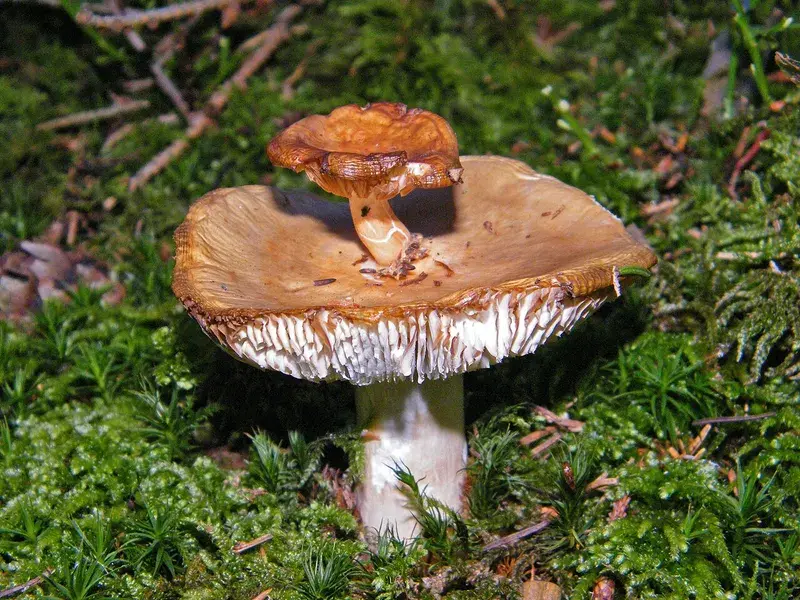
6 to 15 cm, yellow-brown to red-brown, weasel-fur coloured
Underside
gills broad, cream-white
gills cream when young, ochre to buff when ripe
gills cream-white
Stem
white, firm
white, firm
white, spotting brownish
Flesh
white, breaks pale
white, firm
white, very hard
Edibility
Inedible
edible
edible
Habitat & Season
Acidic conifer woodland soils. From the lowlands up to the hills and mountains.
Host trees
Spruce, pine.
Season
Jan
Feb
Mar
Apr
May
Jun
Jul
Aug
Sep
Oct
Nov
Dec
possible good main season
Under spruce and pine.
Burning brittlegill on the map: where does it fit right now?
The map shows every day where weather, soil and forest currently suit this species. The stronger the orange, the better the conditions. Grey means unsuitable. With the day slider you can look up to 13 days ahead. The map shows grid cells, not exact spots.
Unfavourable
Moderate
Favourable
Very good
unsuitable
Burning brittlegill: today's chance of finds in a section of the map. The legend above explains the colours.
Mushroom advice:DGfM: find a mushroom expert. Certified mushroom experts of the German Mycological Society (DGfM).
Collecting rules: Mushrooms that are not specially protected may be collected in small quantities for personal use unless a protected area or ban applies. Certain specially protected edible species (e.g. cep, chanterelle, birch bolete) may be collected in small quantities for personal use.
Collecting rules: At most 2 kg of mushrooms per person per day unless the forest owner has prohibited collecting; organised collecting events are prohibited. Additional state rules apply (collecting hours, closed seasons), e.g. Carinthia, Tyrol, Vorarlberg, Salzburg.
Why it is not edible
Hot taste.
Do not confuse it with mild brittlegills.
Frequently asked questions
Is the burning brittlegill edible?
No, the burning brittlegill is not edible. It is hot-tasting and smells of cedarwood.
When and where does the burning brittlegill grow?
The burning brittlegill grows from June to October on acidic conifer woodland soils under spruce and pine.
Which look-alikes can the burning brittlegill be confused with?
You can confuse it with the nutty brittlegill and the russet brittlegill. The nutty brittlegill tastes mild and almond-like and has an ochre-yellow spore print, whereas the burning brittlegill has a lustreless cap, often a red stem, smells of cedarwood and becomes extremely hot after a while. The russet brittlegill has harder flesh and paler gills.
How do you recognise the burning brittlegill?
The spore print is white. The cap is 4 to 10 cm wide, red-brown, dull and often with scale remnants at the margin.