
Red-staining Inocybe Inosperma erubescens
deadly poisonous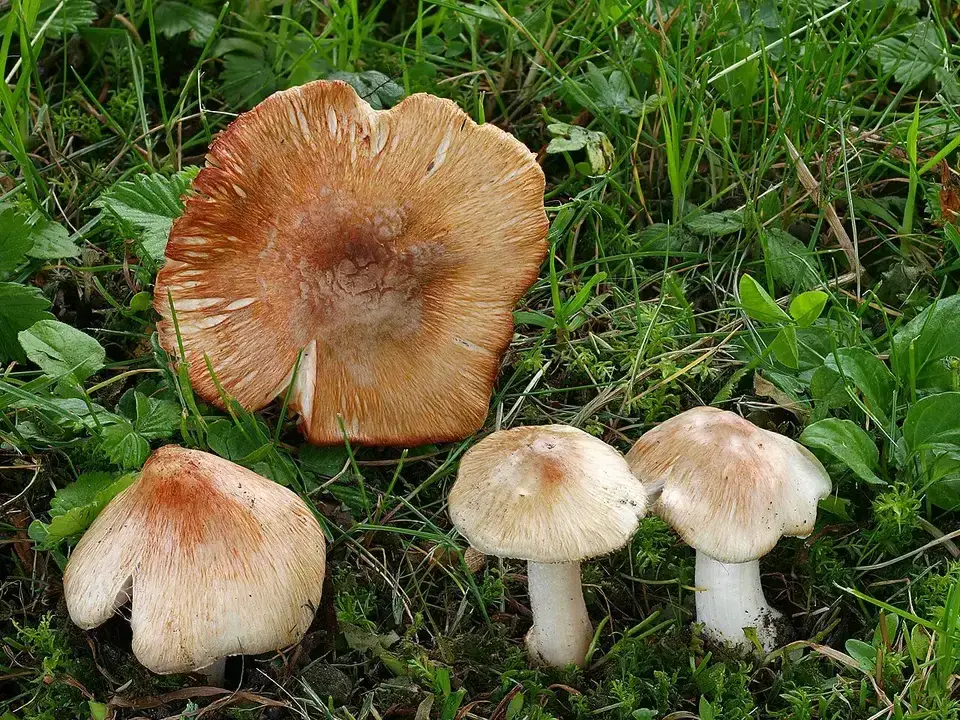

It has a radially fibrous, conical cap, turns red when damaged and gets brownish gills; muscarine poisoning, deaths possible.
View on the map
No matching species found.
Calocybe gambosa (Fr.) Donk · Lyophyllaceae
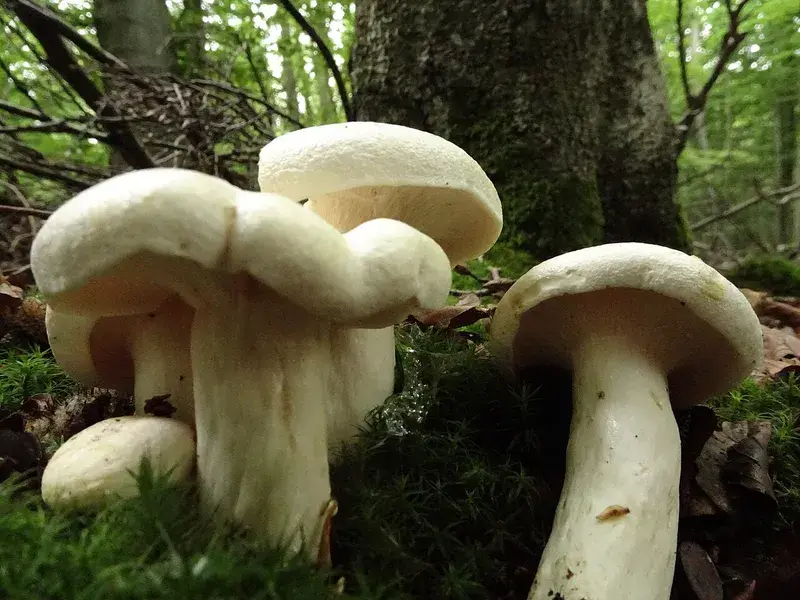
St. George's mushroom grows from April to June; no fixed tree partner; woodland edges, scrub, meadows, gardens. Edible, but only after a certain identification; this page does not replace an in-person check.
Map for this species Mushroom alert for this species How the mushroom alert works
About 20 weeks to go until the typical start of the season in Central Europe.
St. George's mushroom is a compact, whitish to cream-coloured knight mushroom with a strong smell of meal, which appears in rings and rows in spring. It is edible, but can be mistaken for poisonous spring mushrooms.
The highly poisonous Red-staining Inocybe grows at the same time in the same places.
It has a radially fibrous, conical cap, turns red when damaged and gets brownish gills; muscarine poisoning, deaths possible.
View on the map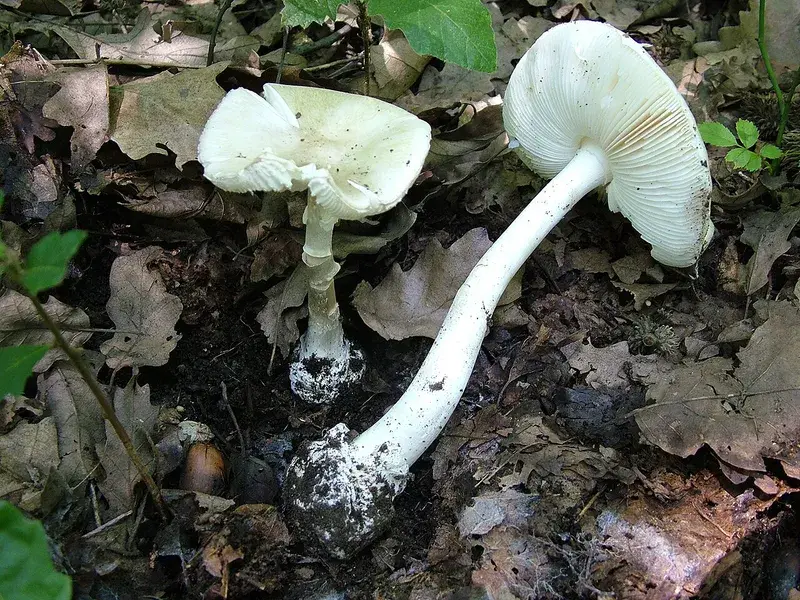
It has a ring and a sac-like volva and does not smell of meal.
View on the map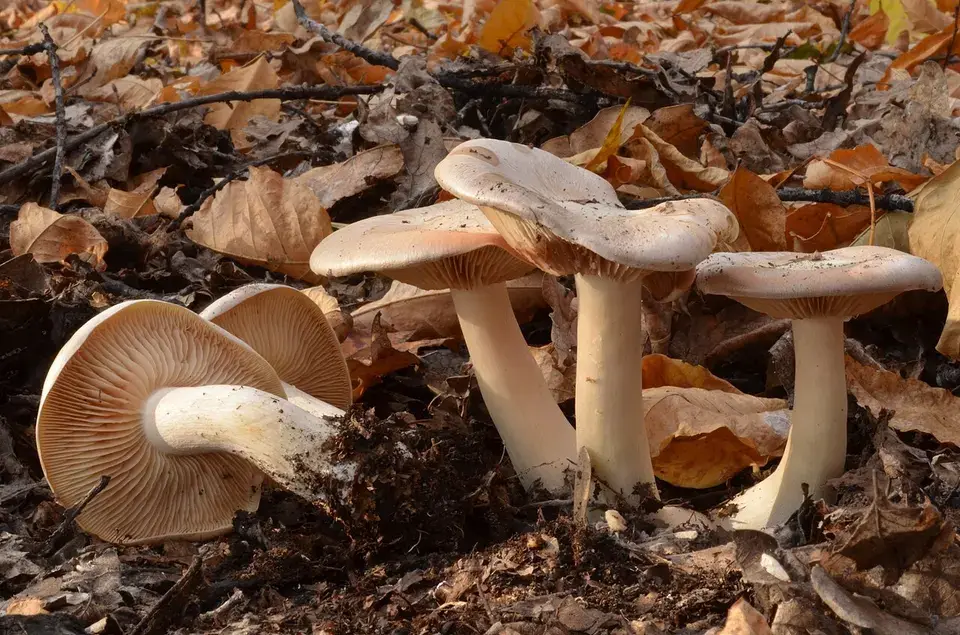
It has yellowish, later pink gills and a pink spore print, and usually appears later in the year.
View on the mapMostly chalky, nutrient-rich soils. The season shifts depending on altitude.
No fixed tree partner; woodland edges, scrub, meadows, gardens.
possible good main season
Main season: May. The weather decides the exact start: often earlier in mild lowlands, later in the mountains and in the north.
The map shows every day where weather, soil and forest currently suit this species. The stronger the orange, the better the conditions. Grey means unsuitable. With the day slider you can look up to 13 days ahead. The map shows grid cells, not exact spots.
Map data: © OSM · CARTO · © Esri, Maxar, Earthstar Geographics, GIS User Community · Weather: Open-Meteo
See St. George's mushroom on the map
Mushroom forecast: where conditions are good for foraging now
| Major region | Occurrence | Season | Main season |
|---|---|---|---|
| Continental (Central Europe) | common | April to June | May |
| Atlantic (western and northwestern Europe) | common | April to June | May |
| Alpine (mountains) | scattered | April to June | May |
| Mediterranean (southern Europe) | regular | April to June | May |
| Hemiboreal (Baltics, southern Scandinavia) | regular | April to June | May |
| Boreal (northern Europe) | rare | April to June | May |
Source: FungiFind species profile. Occurrence is the relative suitability of the major region. The profile uses the same time window for all major regions, so the months are the same everywhere. In the south and in lowlands the season often starts earlier, in the mountains and in the north later.
There are no records per region for this species yet. The country pages lead to all regions with a daily forecast.
How good are the chances of finding this species where you are right now? We calculate it from weather, soil moisture, altitude and forest at your location.
Poison centre:
Emergency: 112 · 999
Poison centre:
Emergency: 112
Mushroom advice: DGfM: find a mushroom expert. Certified mushroom experts of the German Mycological Society (DGfM).
Collecting rules: Mushrooms that are not specially protected may be collected in small quantities for personal use unless a protected area or ban applies. Certain specially protected edible species (e.g. cep, chanterelle, birch bolete) may be collected in small quantities for personal use.
Poison centre:
Emergency: 112 · 144
Mushroom advice: Austrian Mycological Society (ÖMG): mushroom advice. Mushroom advice by the Austrian Mycological Society or regional services such as municipal market offices.
Collecting rules: At most 2 kg of mushrooms per person per day unless the forest owner has prohibited collecting; organised collecting events are prohibited. Additional state rules apply (collecting hours, closed seasons), e.g. Carinthia, Tyrol, Vorarlberg, Salzburg.
Not specially protected.
No species-specific rule known.
Red List Germany: Least concern
Stew or fry only briefly, or it becomes tough. Cook thoroughly.
Poorly suited. Not everyone likes the smell of meal; some people react with intolerance.
Yes, it is considered an edible mushroom. Cook thoroughly. The highly poisonous Red-staining Inocybe grows at the same time in the same places.
St. George's mushroom: in Central Europe usually April to June, main season May. The weather decides the exact start: often earlier in mild lowlands, later in the mountains and in the north. Tree partners and habitat: No fixed tree partner; woodland edges, scrub, meadows, gardens. Soil: Mostly chalky, nutrient-rich soils. Altitude: The season shifts depending on altitude.
The most important one to rule out is Fool's mushroom (Amanita verna, deadly poisonous): It has a ring and a sac-like volva and does not smell of meal. Other look-alikes: Red-staining Inocybe, Livid pinkgill.
No substitute for having your finds checked in person. No guarantee of accuracy. Updated: 17.10.2026.

