Lung oyster grows from June to October; host trees: deciduous wood such as beech, ash, poplar, birch and walnut, as a wood decomposer. Edible, but only after a certain identification; this page does not replace an in-person check.
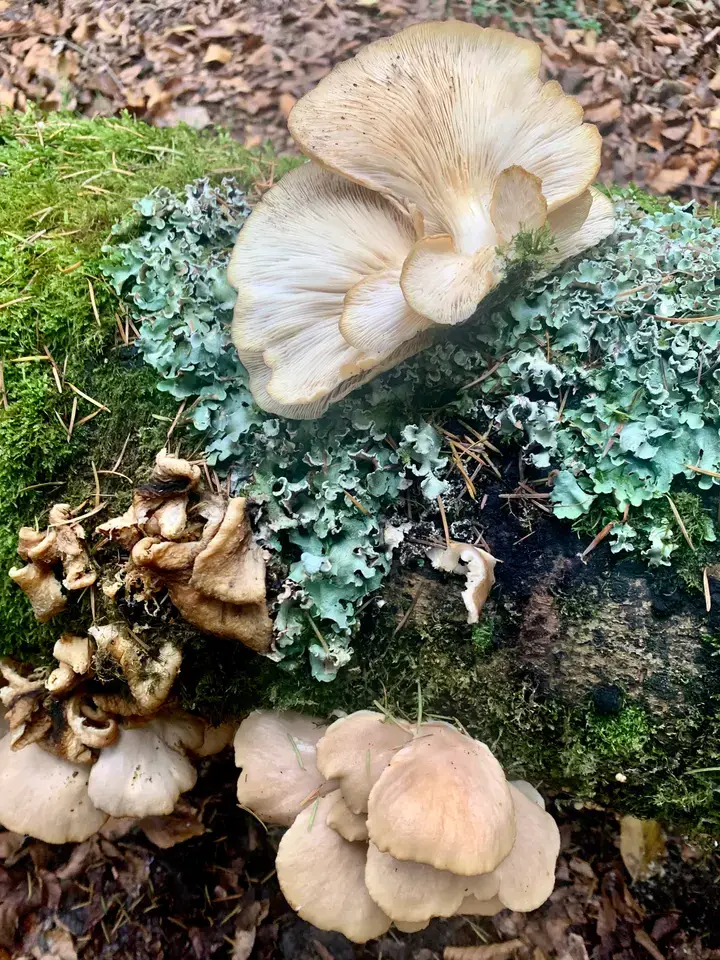
The lung oyster grows in clusters on deciduous wood and is smaller and more delicate than the oyster mushroom. The cap is cream-white to pale beige, never bluish. Fresh fruiting bodies smell of aniseed. It appears in summer and early autumn.
SeasonJune to October
Spore printwhitish to pale lilac-grey
FamilyPleurotaceae
Cap. The cap is shell-shaped to tongue-shaped, cream-white to pale beige, slightly yellowing with age, and without blue tones.
Underside. The gills run down the stem, are white to cream and closer together than in many similar species.
Stem, ring and volva. The stem is short, attached at the side or almost absent, and white-haired at the base. There is no ring and no volva.
Smell and taste. When fresh, the smell is pleasantly of aniseed, and the taste is mild.
Flesh and colour change. The flesh is white and yellows with age.
Lookalikes
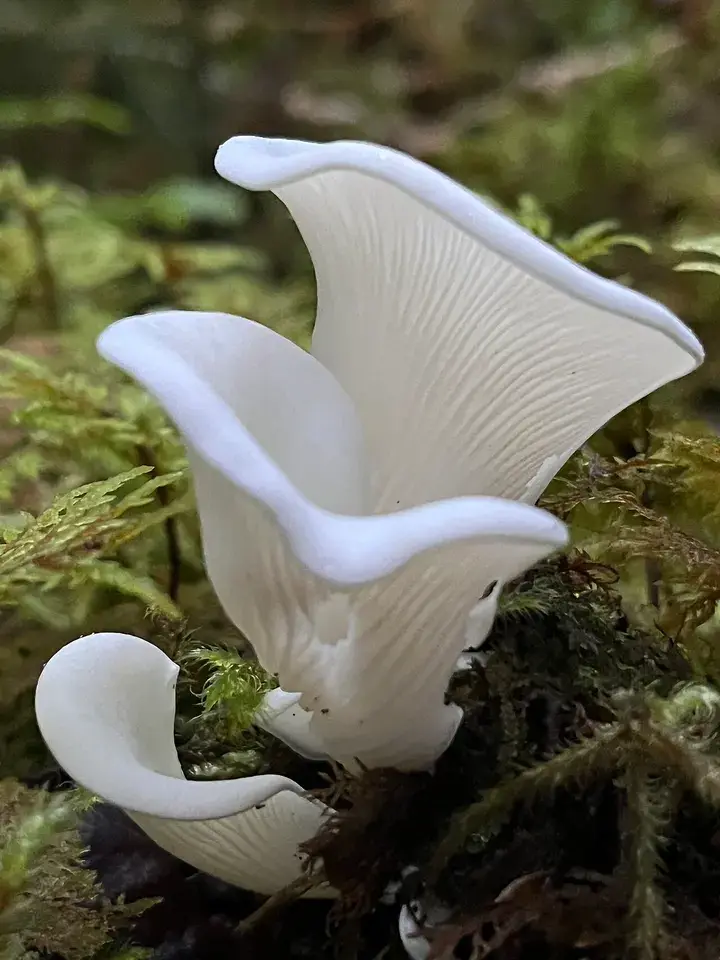
The lung oyster is an edible mushroom and very similar to the oyster mushroom. It grows on deciduous wood. It can be confused with angel's wings, which grows only on conifer wood and is considered poisonous.
It grows only on conifer wood, has no stem, is pure white and has a thin, ear-shaped cap. The lung oyster grows on deciduous wood and has a short stem. Poisonous; severe poisoning is known after eating larger amounts.
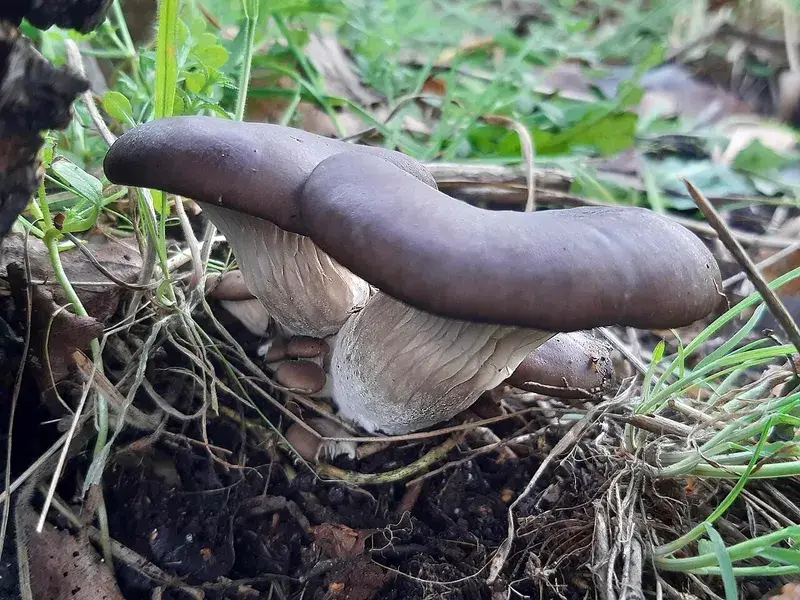
It is larger and sturdier, and the cap is grey to grey-brown or bluish, in contrast to the paler lung oyster. It usually appears from autumn into winter. Also edible.
The gills run far down the stem and form grooves. The cap is ochre-brownish. The lung oyster usually has only a very short, lateral stem. Also edible.
View on the map →
Side by side
Swipe the table sideways
Lung oyster
Angel's wings
Oyster mushroom
Branched oyster
Cap
shell-shaped, cream-white to pale beige, no blue tones
ear-shaped, pure white, thin
grey to grey-brown, sometimes bluish
ochre-brownish to light brown, funnel-shaped
Underside
decurrent, white to cream gills
crowded, white gills
decurrent, whitish gills
gills running far down, forming grooves
Stem
short, lateral, white-haired at the base
absent, cap sits directly on the wood
short, lateral, felty at the base
longer, grooved by the gills
Flesh
tender to firm, older mushrooms tough
thin, delicate, brittle
firm, fleshy
firm, fleshy
Edibility
Edible
deadly poisonous
edible
edible
Habitat & Season
Dead wood and weakened trunks of deciduous trees. No reliable information.
Host trees
Deciduous wood such as beech, ash, poplar, birch and walnut, as a wood decomposer.
Season
Jan
Feb
Mar
Apr
May
Jun
Jul
Aug
Sep
Oct
Nov
Dec
possible good main season
Rough estimate; the fruiting period depends on the weather. The lung oyster appears mainly in summer and early autumn.
Lung oyster on the map: where does it fit right now?
The map shows every day where weather, soil and forest currently suit this species. The stronger the orange, the better the conditions. Grey means unsuitable. With the day slider you can look up to 13 days ahead. The map shows grid cells, not exact spots.
Unfavourable
Moderate
Favourable
Very good
unsuitable
Lung oyster: today's chance of finds in a section of the map. The legend above explains the colours.
How good are the chances of finding this species where you are right now? We calculate it from weather, soil moisture, altitude and forest at your location.
Mushroom advice:DGfM: find a mushroom expert. Certified mushroom experts of the German Mycological Society (DGfM).
Collecting rules: Mushrooms that are not specially protected may be collected in small quantities for personal use unless a protected area or ban applies. Certain specially protected edible species (e.g. cep, chanterelle, birch bolete) may be collected in small quantities for personal use.
Collecting rules: At most 2 kg of mushrooms per person per day unless the forest owner has prohibited collecting; organised collecting events are prohibited. Additional state rules apply (collecting hours, closed seasons), e.g. Carinthia, Tyrol, Vorarlberg, Salzburg.
Conservation and collecting rules
Not specially protected.
In the kitchen
Fried, in sauces or as a vegetable side dish. Use only young, firm caps; older mushrooms turn tough. Cook for at least 15 minutes.
No reliable information on drying. Use only specimens that grow on deciduous wood; on conifer wood the poisonous angel's wings is possible. Stems and older mushrooms are often tough.
Never eat wild mushrooms raw, and always cook them for at least 15 minutes.
Use only young, fresh, maggot-free mushrooms that you have identified with certainty.
Carry mushrooms in an airy basket, not in plastic bags, and process them on the same day.
Frequently asked questions
Is the lung oyster edible?
Yes, it is considered an edible mushroom, similar to the oyster mushroom. It must be cooked thoroughly.
How do I tell it from the oyster mushroom?
The lung oyster is smaller, more delicate and paler, cream-white to pale beige, without blue tones. It appears earlier in the year, mostly in summer and early autumn.
What can it be confused with?
With angel's wings, which grows only on conifer wood, has no stem and is considered poisonous.