Sheathed woodtuft grows from April to November; host trees: grows as a wood decomposer on deciduous wood, more rarely on conifer wood. Edible, but only after a certain identification; this page does not replace an in-person check.
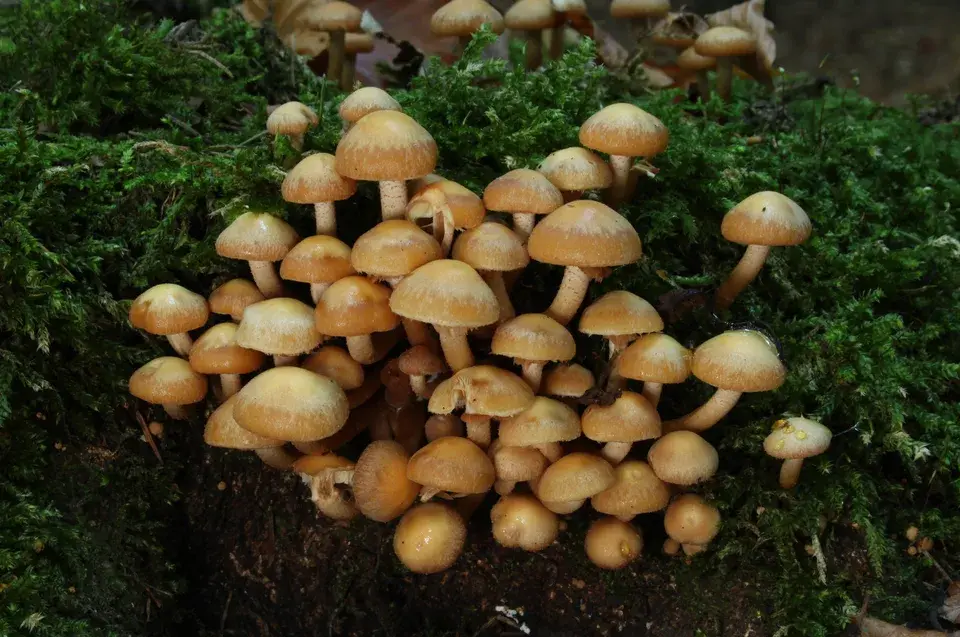
The sheathed woodtuft is a popular edible mushroom that grows in tufts on deciduous wood, more rarely on conifer wood. The cap is brownish-yellowish, greasy-glossy and patchy when damp, and the stem bears a lasting, membranous ring. It can be mistaken for the deadly poisonous funeral bell.
SeasonApril to November
Spore printbrown
FamilyStrophariaceae
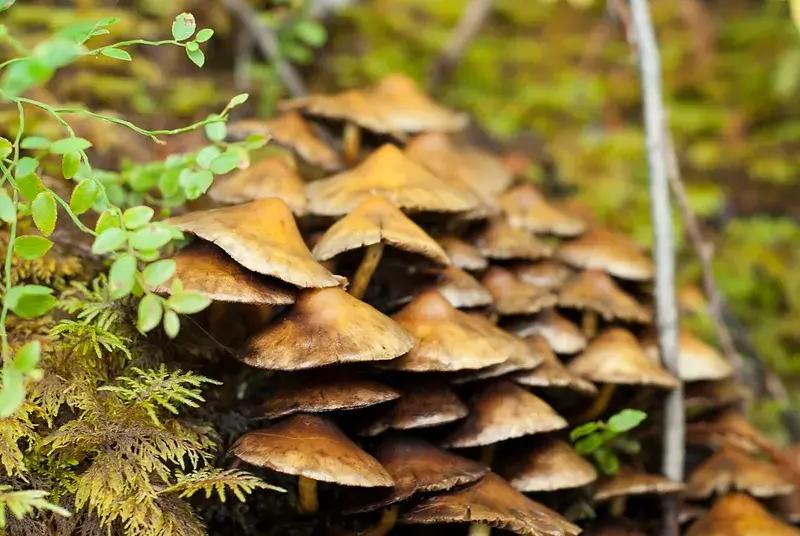
Cap. The cap is small to medium-sized, brownish-yellowish, slightly bumped and thin-fleshed. The cap skin is bald, greasy-glossy and hygrophanous, meaning it becomes patchy when damp.
Underside. The pale brownish gills are slightly decurrent or broadly attached, never free.
Stem, ring and volva. The stem is central and bears a membranous, lasting ring. Below the ring it is scaly. There is no volva.
Smell and taste. It smells and tastes pleasantly mushroomy, without a mealy smell.
Flesh and colour change. The flesh is thin and brownish.
Lookalikes
It grows in tufts on wood and has a brown spore print. The deadly poisonous funeral bell also grows on wood and looks similar. Confusing the two can be fatal, so it is only for confident experts.
It is usually smaller, its stem is smooth and fibrous below the ring instead of scaly, and it smells mealy. The most reliable feature: the scaly stem below the ring in the sheathed woodtuft. Deadly poisonous. If in doubt, do not eat it.
It has a white spore print and small dark scales on the cap. The spore print of the sheathed woodtuft is brown. Edible with restrictions, and only well cooked.
yellow-brown to honey brown, hygrophanous, mostly small
sulphur yellow, centre often orange to brownish
honey yellow to brown with dark small scales
Underside
pale brownish, attached to decurrent gills
attached to decurrent, rust-brown gills
yellowish to olive-green gills
whitish, decurrent gills
Stem
lasting ring, scaly below
thin ring, smooth and fibrous below
yellowish, no lasting ring
fibrous, with ring
Flesh
thin-fleshed, stem fibrous
thin-fleshed, mealy smell
thin-fleshed, bitter
tough stem
Edibility
Edible
deadly poisonous
poisonous
edible with restrictions
Habitat & Season
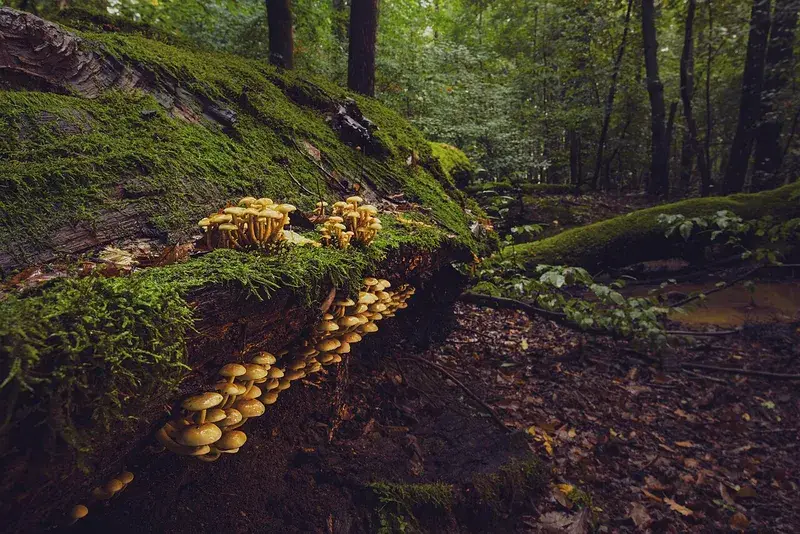
On stumps and dead wood, in tufts and gregarious. No reliable information.
Host trees
Grows as a wood decomposer on deciduous wood, more rarely on conifer wood.
Season
Jan
Feb
Mar
Apr
May
Jun
Jul
Aug
Sep
Oct
Nov
Dec
possible good main season
Rough estimate; the fruiting time depends on the weather.
Sheathed woodtuft on the map: where does it fit right now?
The map shows every day where weather, soil and forest currently suit this species. The stronger the orange, the better the conditions. Grey means unsuitable. With the day slider you can look up to 13 days ahead. The map shows grid cells, not exact spots.
Unfavourable
Moderate
Favourable
Very good
unsuitable
Sheathed woodtuft: today's chance of finds in a section of the map. The legend above explains the colours.
How good are the chances of finding this species where you are right now? We calculate it from weather, soil moisture, altitude and forest at your location.
Mushroom advice:DGfM: find a mushroom expert. Certified mushroom experts of the German Mycological Society (DGfM).
Collecting rules: Mushrooms that are not specially protected may be collected in small quantities for personal use unless a protected area or ban applies. Certain specially protected edible species (e.g. cep, chanterelle, birch bolete) may be collected in small quantities for personal use.
Collecting rules: At most 2 kg of mushrooms per person per day unless the forest owner has prohibited collecting; organised collecting events are prohibited. Additional state rules apply (collecting hours, closed seasons), e.g. Carinthia, Tyrol, Vorarlberg, Salzburg.
Conservation and collecting rules
Not specially protected.
In the kitchen
Use only the caps; the stems are fibrous. Fried, in sauces or soups. Cook for at least 15 minutes.
No reliable information on drying. Risk of confusion with the deadly poisonous funeral bell. Do not eat it if the ring or the stem below the ring has not been checked with certainty.
Never eat wild mushrooms raw, and always cook them for at least 15 minutes.
Use only young, fresh, maggot-free mushrooms that you have identified with certainty.
Carry mushrooms in an airy basket, not in plastic bags, and process them on the same day.
Frequently asked questions
Is the sheathed woodtuft edible?
Yes, it is a popular edible mushroom. But because it can be mistaken for the deadly poisonous funeral bell, identification is tricky.
How does it differ from the funeral bell?
The sheathed woodtuft has a lasting membranous ring and a scaly stem below the ring; the funeral bell has a smooth stem and a mealy smell. If in doubt, do not eat it and ask a mushroom advisor.
Where does the sheathed woodtuft grow?
In tufts on stumps and dead wood, mainly of deciduous trees, more rarely of conifers.
Can it be cultivated on wood?
Yes, the sheathed woodtuft can also be cultivated on wood.