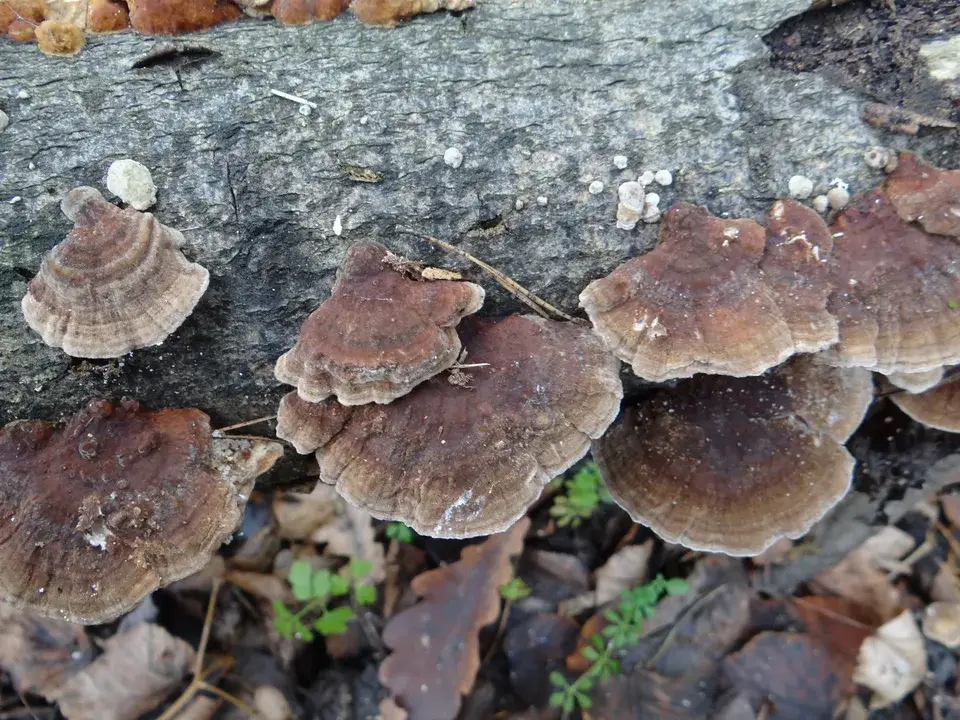
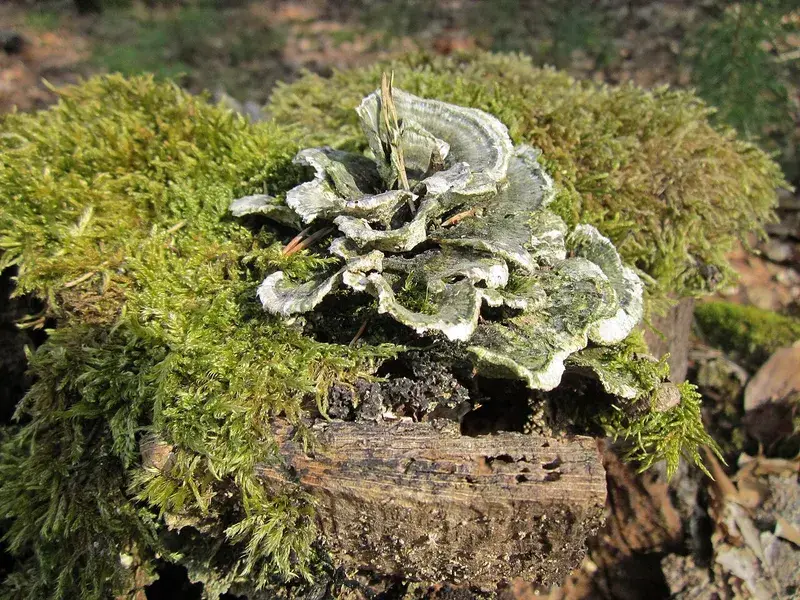
Trametes ochracea grows from all year round; host trees: dead deciduous wood, often beech and oak. Inedible and not for the table; this page does not replace an in-person check.
It has no striking smell, and its spore print is white. Its cap is colourfully zoned and silky-glossy, whereas Trametes ochracea lacks the silky, glossy zones, and its point of attachment is distinctly thicker.
Stumps and fallen trunks. From the lowlands up to the hills and mountains.
Host trees
Dead deciduous wood, often beech and oak.
Season
Jan
Feb
Mar
Apr
May
Jun
Jul
Aug
Sep
Oct
Nov
Dec
possible good main season
All year round on dead wood.
Trametes ochracea on the map: where does it fit right now?
The map shows every day where weather, soil and forest currently suit this species. The stronger the orange, the better the conditions. Grey means unsuitable. With the day slider you can look up to 13 days ahead. The map shows grid cells, not exact spots.
Unfavourable
Moderate
Favourable
Very good
unsuitable
Trametes ochracea: today's chance of finds in a section of the map. The legend above explains the colours.
Mushroom advice:DGfM: find a mushroom expert. Certified mushroom experts of the German Mycological Society (DGfM).
Collecting rules: Mushrooms that are not specially protected may be collected in small quantities for personal use unless a protected area or ban applies. Certain specially protected edible species (e.g. cep, chanterelle, birch bolete) may be collected in small quantities for personal use.
Collecting rules: At most 2 kg of mushrooms per person per day unless the forest owner has prohibited collecting; organised collecting events are prohibited. Additional state rules apply (collecting hours, closed seasons), e.g. Carinthia, Tyrol, Vorarlberg, Salzburg.
Why it is not edible
Tough and leathery.
The point of attachment is often thicker than in the turkey tail.
Frequently asked questions
Is Trametes ochracea edible?
No, Trametes ochracea is not edible. It is tough and has ochre zones without a gloss.
When and where does Trametes ochracea grow?
Trametes ochracea can be found all year round on dead deciduous wood, often on beech and oak, on stumps and fallen trunks.
Which look-alikes can Trametes ochracea be confused with?
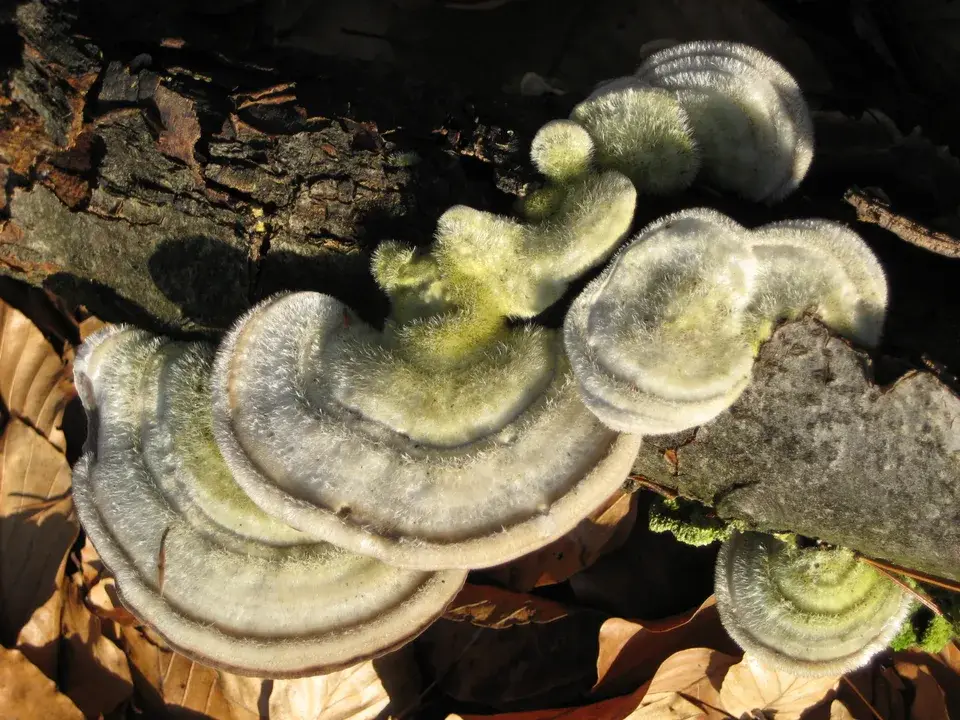
You can confuse it with the turkey tail and the hairy bracket. The turkey tail has no striking smell and a white spore print, and its cap is colourfully zoned and silky-glossy, whereas Trametes ochracea lacks these silky, glossy zones, and its point of attachment is distinctly thicker. The cap of the hairy bracket is grey and coarsely bristly-haired.
How do you recognise Trametes ochracea?
The spore print is white. The caps are 3 to 10 cm wide, thin, concentrically zoned ochre to brown, dull without a silky gloss.