Young puffballs grows from June to October; mostly saprotrophs with no fixed tree partners, on woodland soil, meadows or dead wood, depending on the species. Edible, but only after a certain identification; this page does not replace an in-person check.
Puffballs of the genus Lycoperdon form pear-shaped, bottle-shaped or round fruiting bodies without a cap or gills. The inside is white and firm when young, and later turns olive-brown and puffs out dust when opened. Only young specimens that are pure white inside are edible. This profile covers the group; individual species such as the common puffball can be identified.
SeasonJune to October
Spore printolive-brown (spore mass in the ripe fruiting body)
FamilyAgaricaceae
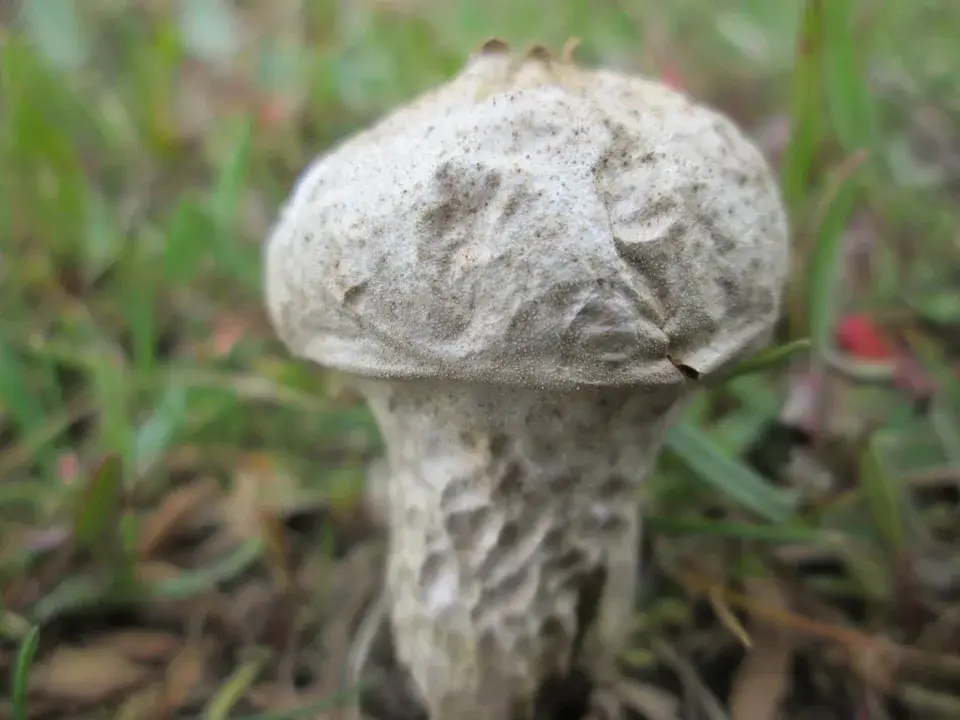
Cap. There is no cap in the usual sense. The fruiting body is roundish to pear-shaped, and in many species the surface has granules or small spines that wipe off easily.
Underside. There are no gills and no tubes. In a cut, a young puffball is evenly white and uniform inside, with no recognisable cap, gill or stem shape.
Stem, ring and volva. The fruiting body has a stem-like, spongy lower part, or sits almost stalkless. There is no ring and no volva. A sac-like volva with a recognisable stem points to a deadly amanita.
Smell and taste. The smell is mild and mushroomy, the taste mild.
Flesh and colour change. The key feature is the lengthways cut: the flesh must be pure white all the way through. Yellowish, olive or dark colouring means the mushroom is too old. Black-violet flesh points to an earthball.
Lookalikes
Group profile: young puffballs are considered edible as long as the inside of the fruiting bodies is pure white and firm. When young, they can be confused with deadly poisonous amanitas in the egg stage. So cut every find in half lengthways.
Photo: No machine-readable author provided. Bernypisa assumed (based on … · CC BY 2.5 · Wikimedia Commons
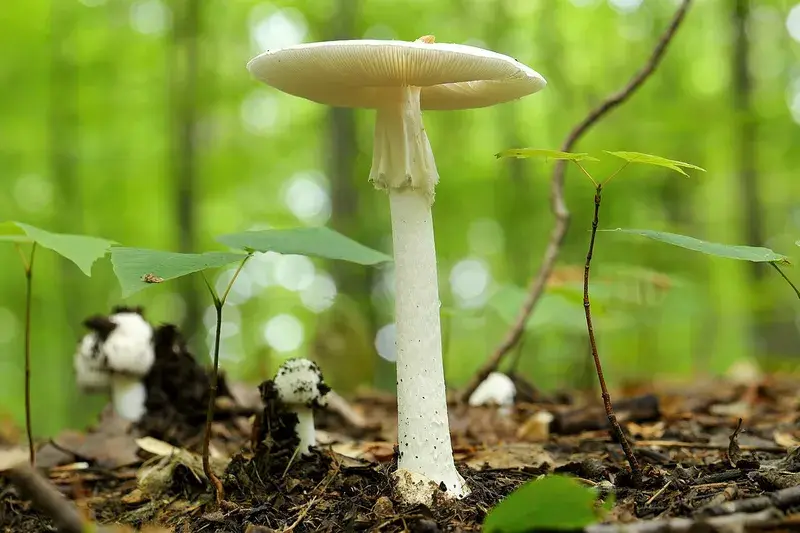
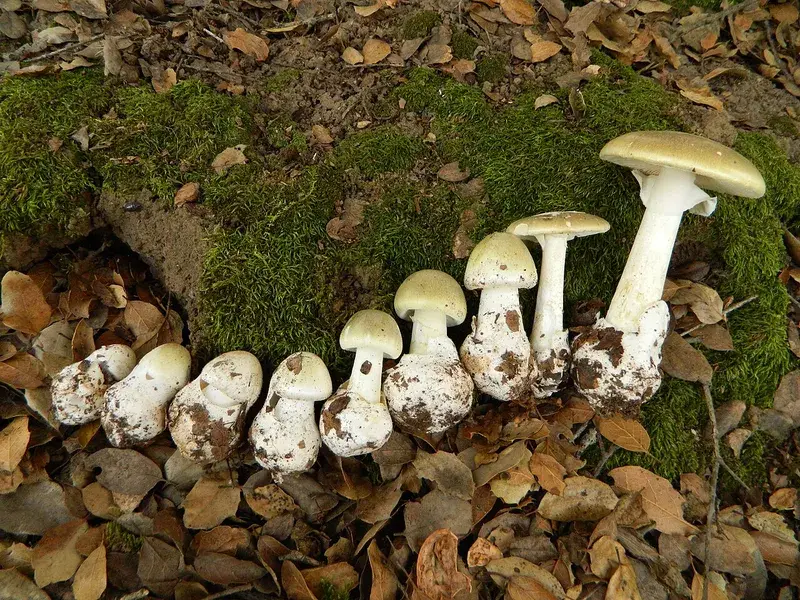
Young deadly amanitas in the egg stage can hardly be told apart from puffballs from the outside. In a lengthways cut you can already see the outline of the cap, gills and stem. A young puffball is evenly white inside, without these structures. Deadly poisonous.
In the egg stage it is also enclosed in a sac. In a lengthways cut the cap and gill primordia are visible, which is not the case in puffballs. The sac, the volva, later remains as a volva on the stem. Deadly poisonous.
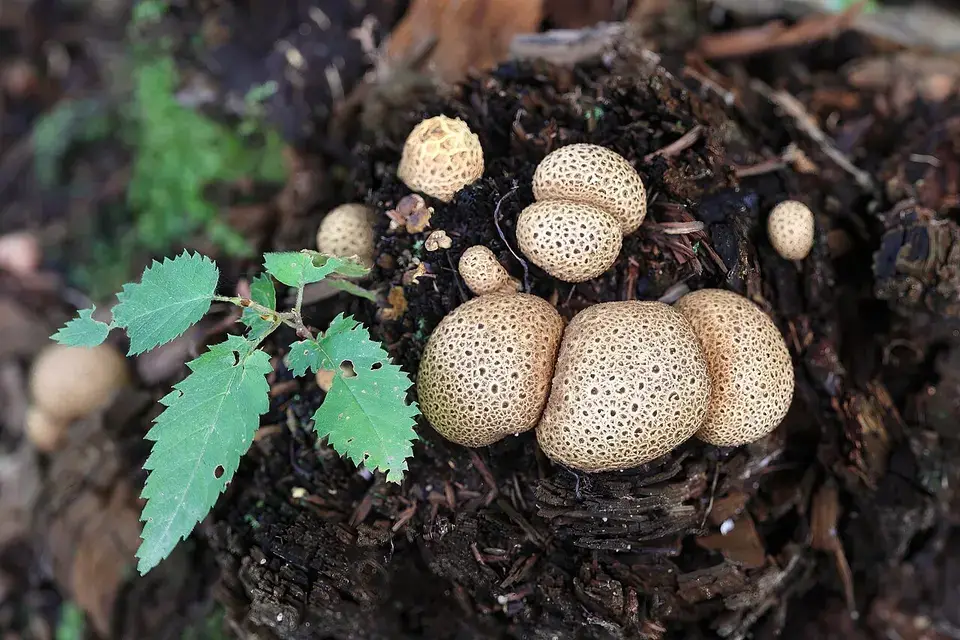
The skin is thick, tough and yellow-brown, and the inside is dark even when young, blackish to violet-black and marbled. A puffball stays pure white inside when young. Poisonous.
roundish to pear-shaped, no cap, granules or spines
cap primordium visible in the cut, white
cap primordium in the cut, often olive-greenish
yellow-brown, tough, cracked into scales
Underside
no gills, pure white and uniform inside when young
gill primordium visible in the cut
gill primordium visible in the cut
inside marbled black-violet when young
Stem
stem-like spongy lower part, no ring or volva
stem primordium with bulb and volva
stem primordium with bulb in a volva
hardly any stem, with mycelial cords in the soil
Flesh
firm and spongy when young, dusty later
firm, but with recognisable structure
firm, structured
tough, hard
Edibility
Edible
deadly poisonous
deadly poisonous
poisonous
Habitat & Season
Woods, woodland edges, meadows and path verges, depending on the species. No reliable information.
Host trees
Mostly saprotrophs with no fixed tree partners, on woodland soil, meadows or dead wood, depending on the species.
Season
Jan
Feb
Mar
Apr
May
Jun
Jul
Aug
Sep
Oct
Nov
Dec
possible good main season
Rough estimate; the fruiting period varies with the species and the weather.
Young puffballs on the map: where does it fit right now?
The map shows every day where weather, soil and forest currently suit this species. The stronger the orange, the better the conditions. Grey means unsuitable. With the day slider you can look up to 13 days ahead. The map shows grid cells, not exact spots.
Unfavourable
Moderate
Favourable
Very good
unsuitable
Young puffballs: today's chance of finds in a section of the map. The legend above explains the colours.
How good are the chances of finding this species where you are right now? We calculate it from weather, soil moisture, altitude and forest at your location.
Mushroom advice:DGfM: find a mushroom expert. Certified mushroom experts of the German Mycological Society (DGfM).
Collecting rules: Mushrooms that are not specially protected may be collected in small quantities for personal use unless a protected area or ban applies. Certain specially protected edible species (e.g. cep, chanterelle, birch bolete) may be collected in small quantities for personal use.
Collecting rules: At most 2 kg of mushrooms per person per day unless the forest owner has prohibited collecting; organised collecting events are prohibited. Additional state rules apply (collecting hours, closed seasons), e.g. Carinthia, Tyrol, Vorarlberg, Salzburg.
Conservation and collecting rules
Not specially protected.
In the kitchen
Use only young specimens that are pure white inside, peel off the outer skin and cut the flesh into slices. Fry briefly in butter or oil; they turn tough easily when cooked. Cook for at least 15 minutes.
No reliable information on drying. Cut every find in half lengthways. Eat it only if the inside is pure white and uniform all the way through. If the inside has turned yellow or dark, do not use it any more. Confusion with deadly amanitas in the egg stage is life-threatening.
Never eat wild mushrooms raw, and always cook them for at least 15 minutes.
Use only young, fresh, maggot-free mushrooms that you have identified with certainty.
Carry mushrooms in an airy basket, not in plastic bags, and process them on the same day.
Frequently asked questions
Are puffballs edible?
Young puffballs are edible as long as the inside is pure white and firm. As they ripen, the inside changes colour and the mushroom can no longer be used.
How do I tell young puffballs from deadly amanitas?
By the lengthways cut: a puffball is uniformly white inside, whereas a deadly amanita in the egg stage already shows the outline of the cap, gills and stem. If in doubt, do not eat it.
Why do puffballs turn tough when cooked?
The flesh is spongy and loses its tenderness with long heating. Frying briefly in butter is the usual preparation, but the cooking time must not be under 15 minutes.
What is the difference from the common earthball?
Earthballs have a thick, tough skin and, even when young, a dark, black-violet marbled inside. They are poisonous.