Half-free morel grows from April to May; host trees: no reliable information. Edible, but only after a certain identification; this page does not replace an in-person check.
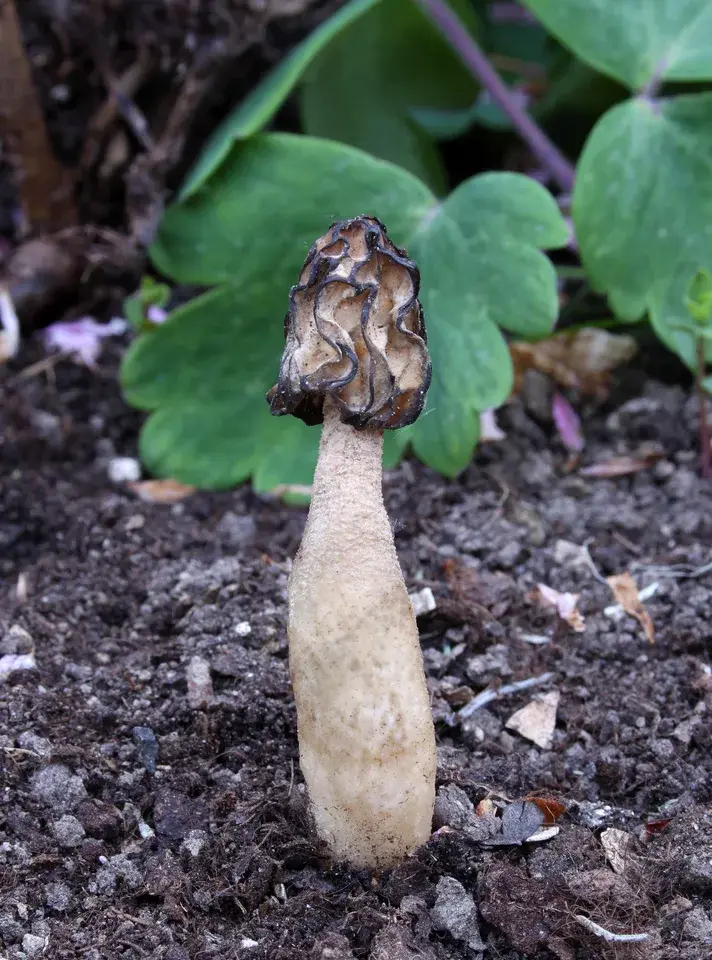
The half-free morel is a spring morel with a small, cap-like head that is joined to the stem only about halfway, and a hollow, granular stem. Overall it grows about 10 to 20 cm tall. Like all morels, it is poisonous raw and must be cooked thoroughly.
SeasonApril to May
Spore printpale yellowish to cream
FamilyMorchellaceae
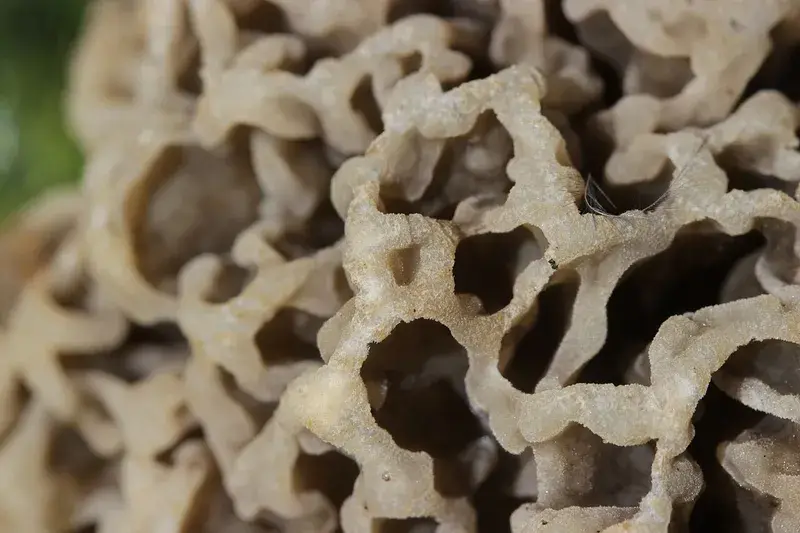
Cap. The cap is small, cap-shaped to conical and joined to the stem only about halfway; the lower edge hangs free like a little skirt. It has honeycomb-like ridges and is brown.
Underside. The underside of the cap is free from the stem. There are neither gills nor tubes; the spore-bearing layer lies in the pits on the outside.
Stem, ring and volva. The stem measures about 4 to 8 cm, is pale, granular to finely scaly and hollow inside. There is no ring and no volva.
Smell and taste. The smell is mild and mushroomy, and the taste is mild.
Flesh and colour change. The flesh is brittle and thin. A striking colour change is not one of its features.
Lookalikes
The half-free morel is an edible mushroom, but it is poisonous raw and must be cooked thoroughly. Dangerous look-alikes are the false morel (deadly poisonous) and the wrinkled thimble-cap (poisonous). The cap is joined to the stem only at about the halfway point.
It has an irregular, brain-like folded, brown cap instead of honeycomb ridges, and often grows under pines in spring. The cap of the half-free morel has honeycomb ridges and is hollow inside. Deadly poisonous, dangerous even after cooking.
The cap is wrinkled instead of honeycomb-ridged and is attached to the stem only at the tip. The half-free morel is joined to the stem about halfway. Poisonous, not recommended as an edible mushroom.
The cap is roundish to egg-shaped and fully joined to the stem at the lower edge. In the half-free morel the cap hangs free. Also edible, poisonous raw.
Deciduous and floodplain woods, on nutrient-rich soils. No reliable information.
Host trees
No reliable information.
Season
Jan
Feb
Mar
Apr
May
Jun
Jul
Aug
Sep
Oct
Nov
Dec
possible good main season
Rough estimate; the fruiting period depends on the weather.
Half-free morel on the map: where does it fit right now?
The map shows every day where weather, soil and forest currently suit this species. The stronger the orange, the better the conditions. Grey means unsuitable. With the day slider you can look up to 13 days ahead. The map shows grid cells, not exact spots.
Unfavourable
Moderate
Favourable
Very good
unsuitable
Half-free morel: today's chance of finds in a section of the map. The legend above explains the colours.
How good are the chances of finding this species where you are right now? We calculate it from weather, soil moisture, altitude and forest at your location.
Mushroom advice:DGfM: find a mushroom expert. Certified mushroom experts of the German Mycological Society (DGfM).
Collecting rules: Mushrooms that are not specially protected may be collected in small quantities for personal use unless a protected area or ban applies. Certain specially protected edible species (e.g. cep, chanterelle, birch bolete) may be collected in small quantities for personal use.
Collecting rules: At most 2 kg of mushrooms per person per day unless the forest owner has prohibited collecting; organised collecting events are prohibited. Additional state rules apply (collecting hours, closed seasons), e.g. Carinthia, Tyrol, Vorarlberg, Salzburg.
Conservation and collecting rules
Morels are protected under nature conservation law in Germany. Collecting is allowed only in small quantities for personal use; observe the rules of the federal states.
In the kitchen
Cut in half lengthways, check thoroughly for dirt and cook well, for example in butter, cream or sauces. Cook for at least 15 minutes.
No reliable information on drying. The half-free morel is poisonous raw, so always cook it thoroughly. Confusion with the false morel can be fatal. Cut open and check every find.
Never eat wild mushrooms raw, and always cook them for at least 15 minutes.
Use only young, fresh, maggot-free mushrooms that you have identified with certainty.
Carry mushrooms in an airy basket, not in plastic bags, and process them on the same day.
Frequently asked questions
Is the half-free morel edible?
Yes, after thorough cooking. It is poisonous raw. Secure identification is important because of the poisonous look-alikes.
How do I recognise the half-free morel?
By the small, cap-shaped head that is joined to the stem only about halfway, and by the hollow, granular stem.
How do I tell it from the false morel?
The false morel has a cap folded like a brain and a chambered stem. The half-free morel has honeycomb ridges and is hollow inside.
Am I allowed to collect morels?
Morels are protected under nature conservation law in Germany. Collecting a small quantity for personal use is allowed; observe regional rules.