
False morel Gyromitra esculenta
deadly poisonous
Its cap is brain-like, folded and red-brown, chambered inside and not continuously hollow.
View on the map
No matching species found.
Morchella esculenta (L.) Pers. · Morchellaceae
Also: Morel, Yellow morel, True morel
Finding morels: when the morel season starts, where morels grow and how to tell them safely from the false morel.
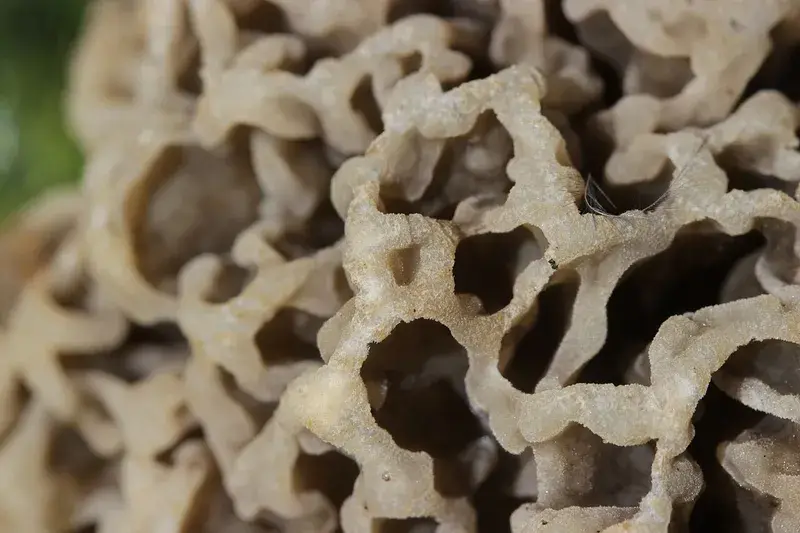
Common morel grows from March to May; host trees: ash, elm, fruit trees, also poplar; floodplain woods, parks, gardens. Edible, but only after a certain identification; this page does not replace an in-person check.
Where are morels growing now? Open the map Mushroom alert for this species How the mushroom alert works
In Central Europe morels usually grow March to May, mainly under ash, poplar and old fruit trees on chalky soil.
| Major region | Occurrence | Start of season | Main season |
|---|---|---|---|
| Continental (Central Europe) | common | mid-March | April |
| Atlantic (western and northwestern Europe) | regular | mid-March | April |
| Alpine (mountains) | regular | mid-March | April |
| Mediterranean (southern Europe) | regular | mid-March | April |
| Hemiboreal (Baltics, southern Scandinavia) | common | mid-March | April |
Rough guide from the FungiFind species profile. The profile uses the same time window for all major regions, there are no separate start dates per region. Major regions where the morel is rare are left out.
As of:
Season status: still in winter break
About 15 weeks to go until the typical start of the season in Central Europe. Typical start: .
The map shows what it looks like where you live: where conditions suit morels today and how they develop over the next few days. Open the map for your area →
Save favourite spots and get notified as soon as the chance of finds there is good.
See morels on the map Set up a Fungi-Alert
A free account gives you your first Fungi-Alert, Plus adds Fungi-Alerts for more favourite spots. See prices
Cut the mushroom in half lengthwise: a morel is hollow throughout, the poisonous false morel is chambered inside and has a brain-like cap.
The false morel grows at the same time as the morel and is often mistaken for it. These features tell them apart:
| Common morel Morchella esculenta | False morel Gyromitra esculenta | |
|---|---|---|
| Cap | honeycomb of pits and ridges, yellowish, grey to ochre brown | brain-like folds, reddish brown to dark brown, no honeycomb |
| Cut lengthwise | hollow throughout: cap and stem form one single cavity | chambered and convoluted inside, partly stuffed with cottony tissue, no single cavity |
| Stem | whitish, scurfy, often thickened at the base | short, whitish, furrowed, chambered inside |
| Habitat | ash, fruit trees, poplar; chalky soils | mainly pine, also spruce; sandy, acidic soils |
| Time | March to May | March to May |
| Toxin | poisonous raw or undercooked, edible only when cooked through | contains gyromitrin, deadly poisonous, do not eat it even boiled or dried |
The common morel is a spring mushroom with a pale, honeycomb-like chambered cap that forms a single hollow space with the stem. It is a sought-after edible mushroom, but edible only when well cooked.
Poisonous raw; the false morel is a dangerous look-alike at the same time of year.
Its cap is brain-like, folded and red-brown, chambered inside and not continuously hollow.
View on the map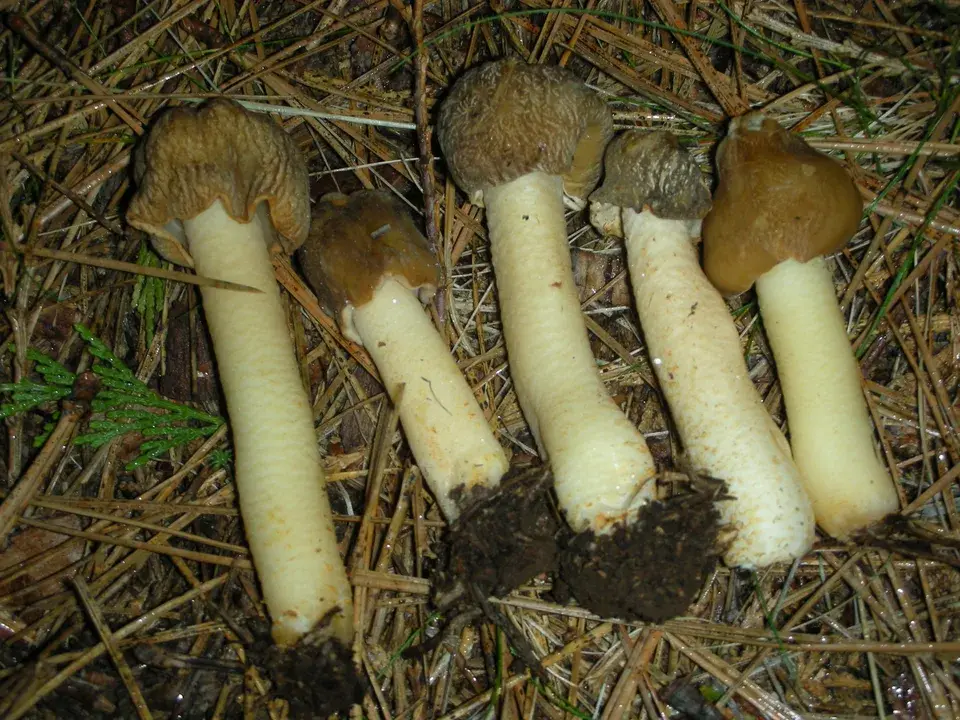
The smooth to wrinkled cap sits on the stem only at the top, like a thimble.
View on the map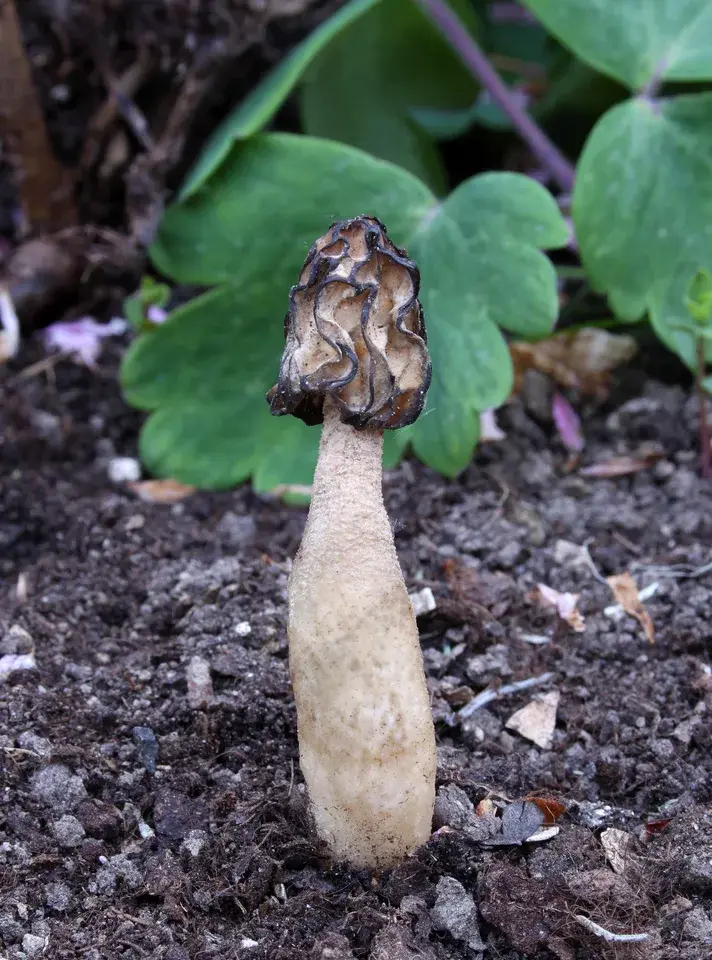
The cap is small and attached only for half its length to the long stem; the lower cap margin hangs free.
View on the mapChalky, nutrient-rich soils, also bark mulch. It is absent at higher mountain altitudes.
Ash, elm, fruit trees, also poplar; floodplain woods, parks, gardens.
possible good main season
Main season: April. The weather decides the exact start: often earlier in mild lowlands, later in the mountains and in the north.
The map shows every day where weather, soil and forest currently suit this species. The stronger the orange, the better the conditions. Grey means unsuitable. With the day slider you can look up to 13 days ahead. The map shows grid cells, not exact spots.
Map data: © OSM · CARTO · © Esri, Maxar, Earthstar Geographics, GIS User Community · Weather: Open-Meteo
Mushroom forecast: where conditions are good for foraging now
Morels grow mainly in floodplain woods, near ash, poplar and old fruit trees on chalky soil, and the black morel also in conifer woods and on burnt ground.
Morels do not grow just anywhere in the woods, they prefer quite specific spots. Which ones depends on the species:
On the FungiFind map you can see where tree species, soil and terrain in your area suit the common morel. It shows where conditions are right, not individual finds. See suitable spots near you →
Morels appear in spring, typically from mid-March, often earlier after mild winters and later in the mountains.
In the lowlands the season typically starts in mid-March. After mild winters with little snow, morels often appear earlier than usual, and with the right weather the black morel sometimes shows up as early as late February.
In the mountains the black morel follows the snow: it appears at the edges of melting old snowfields. Experienced foragers watch how the temperature develops and how much rain has actually fallen.
Reliable indicator plants that tell you the start of the season are not documented in the specialist literature. Rely on the weather and the chance of finds instead.
The map recalculates the chance of finds every day from weather and soil moisture. With the day slider you can look up to 13 days ahead and see when good conditions are building up after rain and mild weather. See the chance of finds for the coming days →
Morels can now be cultivated, in fields in China and indoors in Denmark, but there is no reliable method for gardens.
For a long time morels were considered almost impossible to grow. Their life cycle is complicated: the resting bodies (sclerotia) readily produce mycelium, but getting it to fruit only works under exactly the right conditions.
In the USA, Ower achieved a first indoor breakthrough in the 1980s. Production there was stopped in 2008 because of low yields and bacterial contamination. In China morels have been grown commercially in fields since about 2012, and the area grew to more than 2,600 hectares by 2016, mostly with Morchella importuna. Yields there vary a lot.
In Denmark the Kirk brothers developed a method to grow black morels indoors all year round. It is patented, and commercial production is only planned once the process is further automated.
For the garden you can buy instructions and spawn, but there are no reliable figures on success. If you try it, be prepared for years without a single morel.
The word morel comes from French, and the scientific name Morchella esculenta goes back to Persoon in 1801.
The English word morel comes from French and is recorded from the second half of the 17th century.
Carl Linnaeus described the common morel in 1753 as Phallus esculentus. It got its current name, Morchella esculenta, from Christiaan Hendrik Persoon in 1801. Esculenta is Latin and means edible.
Morels are sought after and expensive, and drying keeps them for a long time. The similar false morel used to be traded and even preserved as well, until a sales ban came in across western and central Europe.
In the UK, picking wild mushrooms for your own use is not theft, but removing fungi from land needs the landowner’s permission.
Rules depend on the country and on the place where you pick:
Take only what you need yourself, leave very young and old fruit bodies and have every find checked by a mushroom expert.
Regions with many documented records (GBIF). Each region page has the daily forecast.
How good are the chances of finding this species where you are right now? We calculate it from weather, soil moisture, altitude and forest at your location.
Poison centre:
Emergency: 112 · 999
Poison centre:
Emergency: 112
Mushroom advice: DGfM: find a mushroom expert. Certified mushroom experts of the German Mycological Society (DGfM).
Collecting rules: Mushrooms that are not specially protected may be collected in small quantities for personal use unless a protected area or ban applies. Certain specially protected edible species (e.g. cep, chanterelle, birch bolete) may be collected in small quantities for personal use.
Poison centre:
Emergency: 112 · 144
Mushroom advice: Austrian Mycological Society (ÖMG): mushroom advice. Mushroom advice by the Austrian Mycological Society or regional services such as municipal market offices.
Collecting rules: At most 2 kg of mushrooms per person per day unless the forest owner has prohibited collecting; organised collecting events are prohibited. Additional state rules apply (collecting hours, closed seasons), e.g. Carinthia, Tyrol, Vorarlberg, Salzburg.
Specially protected under BArtSchV Annex 1 (Morchella spp.); collecting small quantities for personal use is allowed under Section 2 BArtSchV.
No species-specific rule known.
Red List Germany: Least concern
Morels are poisonous raw and must only be eaten thoroughly cooked, and even then not in large amounts.
Raw morels are poisonous. Their toxins are only destroyed by sufficient heating, so always cook morels thoroughly and never taste them raw.
Poorly cooked morels cause stomach and gut problems. French poison centres also describe a neurological syndrome with tremor and unsteadiness that occurred more often after large amounts. So do not eat large portions.
Dried morels keep for a long time. Only eat finds that are identified with certainty, and if in doubt have them checked by a mushroom expert.
Yes, it is considered an edible mushroom. Cook thoroughly for at least 15 minutes; poisonous raw and undercooked. Poisonous raw; the false morel is a dangerous look-alike at the same time of year.
Common morel: in Central Europe usually March to May, main season April. The weather decides the exact start: often earlier in mild lowlands, later in the mountains and in the north. Tree partners and habitat: Ash, elm, fruit trees, also poplar; floodplain woods, parks, gardens. Soil: Chalky, nutrient-rich soils, also bark mulch. Altitude: It is absent at higher mountain altitudes.
The most important one to rule out is False morel (Gyromitra esculenta, deadly poisonous): Its cap is brain-like, folded and red-brown, chambered inside and not continuously hollow. Other look-alikes: Half-free morel, Thimble morel.
Only with a lot of uncertainty. In China morels have been grown in fields since about 2012, and in Denmark there is a patented indoor method. For gardens there are no reliable figures on success.
Picking wild mushrooms for your own use is not theft under the Theft Act 1968, unless you pick for sale. Removing fungi from land needs the landowner’s permission, and many sites have their own rules.
Raw morels are poisonous, and their toxins are only destroyed by thorough heating. Even cooked, you should not eat large amounts.
Pick spots on the map where tree species, soil and weather suit morels, and keep an eye on them in spring. With a Fungi-Alert you do not have to check every day:
Save favourite spots and get notified as soon as the chance of finds there is good.
No substitute for having your finds checked in person. No guarantee of accuracy. Updated: 27.11.2026.

