Mottled bolete grows from June to October; host trees: birch only. Edible, but only after a certain identification; this page does not replace an in-person check.
The mottled bolete is a scaber stalk that lives only with birches and prefers marshy, acidic sites. Its flesh turns pink and bluish in the air, and at the stem base it is often blue-green. It is edible, but rarer than the birch bolete and should be spared.
SeasonJune to October
Spore printyellowish olive to brownish
FamilyBoletaceae
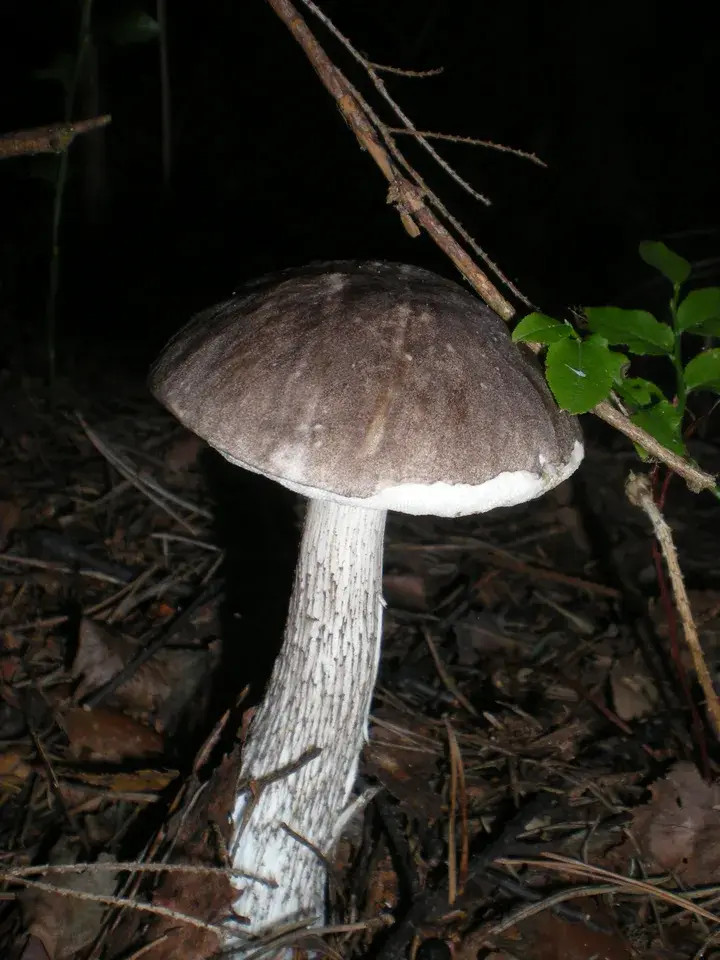
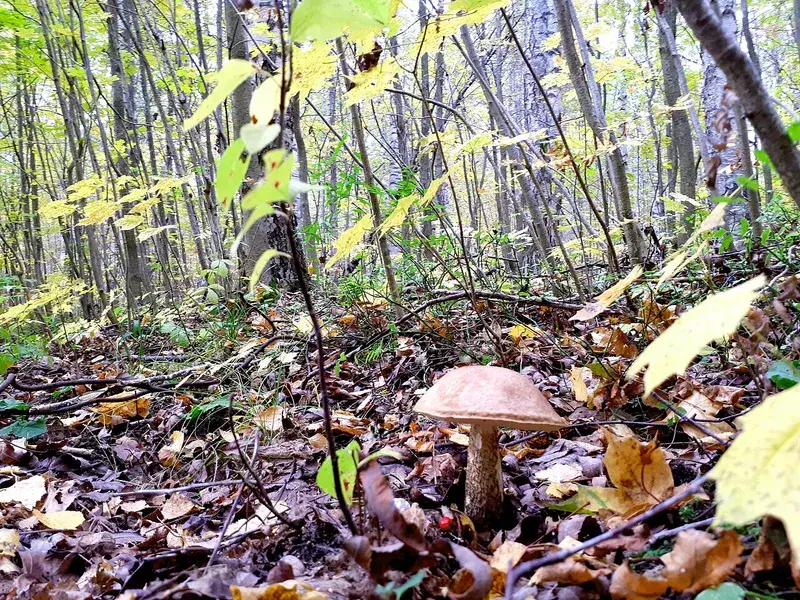
Cap. The cap is 5 to 15 cm wide, at first hemispherical, later cushion-like. The cap skin is pale grey-brown to reddish brown, later often browner, smooth, bald, dry and rather slimy when damp.
Underside. The tubes are white, pale pink or cream when young and later dirty cream. They are strongly depressed around the stem, and the tube layer detaches easily from the cap flesh.
Stem, ring and volva. The stem is 5 to 15 cm long, 1 to 3.5 cm thick, slender, white and covered with dark to black scales. The stem base is often coloured green-blue. There is no ring and no volva.
Smell and taste. The smell is unremarkable, the taste mild.
Flesh and colour change. The flesh is whitish to cream, firm when young, later spongy. In the air it turns pale pink, later bluish colours appear. It turns black when cooked.
Lookalikes
It has tubes instead of gills and a white stem with dark scales, and grows near birches. All scaber stalks are edible, and the similar birch boletes are too. Raw, they are not tolerated.
Its flesh is unchanging when broken, and the stem base does not turn blue. The strongest distinguishing feature is the blue-green stem base and the flesh turning pink to bluish in the mottled bolete. Also edible.
It also has a stem base that turns blue; a safe separation in the field is usually possible only for experts. Also edible.
View on the map →
Side by side
Swipe the table sideways
Mottled bolete
Birch bolete
Leccinum cyaneobasileucum
Cap
pale grey-brown to reddish brown, 5 to 15 cm, slimy when damp
pale grey-brown to reddish grey-brown, 5 to 15 cm
pale grey-brown
Underside
whitish to cream-coloured tubes
white, later grey tubes
whitish tubes
Stem
white, dark-scaled, base often blue-green
white, dark-scaled, base not discoloured
white, dark-scaled, base bluish
Flesh
firm when young, later spongy, flesh pink to bluish
firm when young, later spongy, flesh unchanging
soft, watery
Edibility
Edible
edible
edible
Habitat & Season
Marshy, acidic sites and bogs. It does not occur on calcareous soil. No reliable information.
Host trees
Birch only.
Season
Jan
Feb
Mar
Apr
May
Jun
Jul
Aug
Sep
Oct
Nov
Dec
possible good main season
It grows within the range of birch, preferring bogs and marshes.
Mottled bolete on the map: where does it fit right now?
The map shows every day where weather, soil and forest currently suit this species. The stronger the orange, the better the conditions. Grey means unsuitable. With the day slider you can look up to 13 days ahead. The map shows grid cells, not exact spots.
Unfavourable
Moderate
Favourable
Very good
unsuitable
Mottled bolete: today's chance of finds in a section of the map. The legend above explains the colours.
How good are the chances of finding this species where you are right now? We calculate it from weather, soil moisture, altitude and forest at your location.
Mushroom advice:DGfM: find a mushroom expert. Certified mushroom experts of the German Mycological Society (DGfM).
Collecting rules: Mushrooms that are not specially protected may be collected in small quantities for personal use unless a protected area or ban applies. Certain specially protected edible species (e.g. cep, chanterelle, birch bolete) may be collected in small quantities for personal use.
Collecting rules: At most 2 kg of mushrooms per person per day unless the forest owner has prohibited collecting; organised collecting events are prohibited. Additional state rules apply (collecting hours, closed seasons), e.g. Carinthia, Tyrol, Vorarlberg, Salzburg.
Conservation and collecting rules
Because of its rarity, sparing the species is recommended.
In the kitchen
Use only young, firm mushrooms; older flesh becomes spongy and watery. The flesh turns black when cooked, which is normal. Cook for at least 15 minutes.
No reliable information on drying. Not tolerated raw. Better to spare it because of its rarity.
Never eat wild mushrooms raw, and always cook them for at least 15 minutes.
Use only young, fresh, maggot-free mushrooms that you have identified with certainty.
Carry mushrooms in an airy basket, not in plastic bags, and process them on the same day.
Frequently asked questions
Is the mottled bolete edible?
Yes, like the birch bolete it is edible. Because of its rarity, however, it should be spared.
How do you recognise it?
By the white, dark-scaled stem with an often blue-green base and the flesh that turns pale pink and later bluish in the air, in association with birches.
How does it differ from the birch bolete?
The flesh of the birch bolete is unchanging when broken, and the stem base does not turn blue.
Where does it grow?
Only near birches, preferably in bogs and marshes on acidic soils, from June to October.